2025 Full Year Results
The Lloyd’s market produced a strong set of results in 2025 with profit before tax of £10.6bn, up 10.1%.

19 March 2025
It is a privilege to write my first statement as Chief Executive of Lloyd’s. I am grateful for the support I have received from the market and colleagues since my appointment in June. It has been both humbling and energising.
Over recent months I have spent time talking to colleagues, market participants and investors as we shaped our strategy. Those conversations have reconfirmed to me this institution’s unique strength: Lloyd’s can shoulder more insurance risk for each unit of capital than any other organisation in the world.
The external environment underlines the importance of such an attribute. The traditional world order, trade flows and security alliances that created the conditions for broad-based stability since the end of the Cold War are coming under pressure.
At the same time, renewed investment in defence capabilities, energy security and infrastructure — particularly in advanced manufacturing and artificial intelligence — is creating the requirement for new categories of complex cover.
The AI shift is driving significant investment into the real economy, creating new insurable assets and exposures. It is also reshaping the nature of risk itself, from life sciences to kinetic conflict.
Taken together, these developments dramatically alter the risk-reward calculus. This context highlights the value in a stable and neutral marketplace for managing risk.
Lloyd’s benefits from 337 years of lived experience. It has endured countless wars, multiple financial crises and at least four industrial revolutions. The characters and context change. But Lloyd’s underlying role — to host a marketplace that understands, prices and therefore helps manage emerging risks — does not.
Our global footprint, combined with deep local engagement, allows us to support people, communities and businesses as they navigate political and economic complexity.
I believe the Lloyd’s market is well positioned to deliver financial returns and increase its global relevance.
The Lloyd’s market produced a strong set of results in 2025 with profit of £10.6bn, up 10.1% and beating the forecast set out at the start of the year.
The market maintained underwriting discipline, delivered innovative structured solutions and benefitted from a conservative investment policy. The balance sheet remains very strong, positioning the market well for the next phase of the cycle.
I would like to congratulate market participants for their professionalism in delivering these results. I would also like to thank members for supporting the market with their capital, and Corporation colleagues for their hard work over the past 12 months.
While the financial toll on the Lloyd’s market from catastrophes this year has been modest, the human toll has been a heavy one. We never lose sight of those whose lives have been lost, shattered or upended.
In March 2025, the Lloyd’s market forecast gross written premiums of £60bn for the year. The market closed the year at £58bn, an increase of 4.2% compared to 2024 and comfortably within the 5% guidance range, demonstrating discipline in the face of moderating pricing conditions.
Growth was mostly derived from areas where the market rightly saw price adequacy and from structured products and portfolio solutions.
The underlying combined ratio — defined as the combined ratio, excluding major losses — was 81.8% in 2025, 2.7 percentage points higher than the prior year, while remaining indicative of disciplined underwriting and resilient underlying profitability.
The full-year combined ratio closed at 87.6%, driven by comparatively benign catastrophe losses in the second half of the year. The Californian wildfires in the first quarter was the largest event of the year. Major claims were again below the ten-year average of 10.4% and below market forecasts.
The attritional loss ratio remained relatively stable at 47.9%, compared to 47.1% in 2024. Prior year releases were (1.7)%, down 0.7 percentage points from 2024, with favourable movement in Property exposures partly offset by strengthening in Aviation and Casualty reserves.
The expense ratio increased to 35.6% up 1.2 percentage points, reflecting profitability-driven commissions, mix-driven acquisition costs and foreign‑exchange impacts. This is a trend that we and the market must pay close attention to in 2026.
The composition of growth over the past year is instructive. Existing syndicates delivered 7.2% volume growth. New syndicates contributed a further 3.1%. This exposure growth was partly offset by price decreases of (3.7)% following seven years of strengthening and a (2.4)% foreign exchange headwind.
The market continues to allocate capital to sectors and classes where it sees price adequacy and structural opportunities. Reinsurance enjoyed the strongest expansion during 2025, driven by new entrants and innovative structured solutions.
Property continued to grow, albeit at a slower pace in competitive US direct and facultative markets. The overall business mix remains stable with the only notable new area of interest being trade credit.
The platform itself continues to generate high interest from potential new entrants. During the year, Lloyd’s received more than 50 serious underwriting enquiries. Seven new syndicates commenced business in 2025, with a further 13 launching on 1 January 2026.
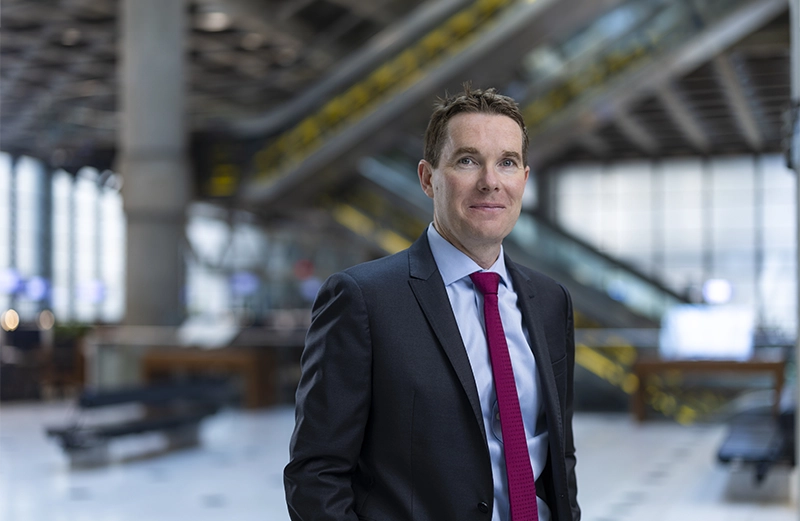
These results provide a firm foundation on which to build for the future. My focus is on setting a clear strategic direction that sharpens our financial edge and maximises our unique capital advantage.Patrick Tiernan, Lloyd's Chief Executive
The investment return from Lloyd’s conservative and well-balanced portfolio also exceeded forecasts. A significant proportion of that return was derived from income in the form of interest and dividends, along with mark-to-market gains on fixed income assets.
Assets remain predominantly allocated to high-quality government and corporate bonds. Although the framework allows for greater allocation to equities and alternatives, this has been used cautiously. The emphasis remains on capital preservation, liquidity and alignment with the risk profile of underwriting liabilities.
Strong underwriting and investment performance resulted in a return on capital of 22.0% in 2025. This is the third year in a row in which returns on capital have exceeded 20%. However, the ten year rolling average is still in single figures at 9.5%.
It should be noted that, while mean return on equity has been solid, there is a fair dispersion among syndicates. Historical evidence demonstrates that the better performers at Lloyd’s maintain returns across the cycle. As we prepare for more difficult conditions, it is worth restating that we will not stand idly by and let poor cycle management drag down the market.
In many areas, and particularly in large US commercial accounts, pricing conditions are getting tougher and volatility is increasing. However, our requirements remain constant: we expect and will support underwriting discipline, innovative growth and sustainable returns.
Touching briefly on the outlook, our forecast for 2026, based on market submissions, is for gross written premium of £64bn (+/-5%), a combined ratio of 90% to 95% and investment return of 3%.
We are confident in the market’s ambitions based on the commitment to underwriting and expense discipline and growth driven by sectors and classes where rate adequacy remains strongest. Forecasts are conservative and do not rely on prior-year reserve releases.
These results provide a firm foundation on which to build for the future. My focus is on setting a clear strategic direction that sharpens our financial edge and maximises our unique capital advantage to ensure Lloyd’s is the pre-eminent global marketplace for insurance risk.
At its core, Lloyd’s is a marketplace, stewarded by the Corporation on behalf of its members. Our role is to protect and advance the market — protect it by maintaining underwriting discipline and our financial strength; advance it by attracting expertise, innovation and scale.
Seen through that lens, our strategic choices become clearer. Over the past few months, I have taken a hard look at Lloyd’s strengths and its position in the global insurance landscape. We are performing well, but we are not yet performing at our full potential.
Our strategy is designed to raise the bar. That requires us to build on what is distinctive about Lloyd’s while removing the friction that constrains performance. We will foster a faster, simpler operating environment, informed by principles-based oversight, clearer reporting and more predictable decision making.
The strategy has four drivers. First, leading underwriting performance. Sustainable profitability through-the-cycle remains the primary measure of success. We will promote expertise and underwriting discipline, while remaining bold in embracing nascent risks.
Second, building a more efficient marketplace. We will reduce friction, lower costs and create predictable, risk-based oversight so that capital and talent can move at pace.
Third, maximising our capital advantage. Our unique structure allows more risk to be taken per unit of capital than elsewhere. We will protect and deploy that advantage to increase returns for the same level of risk.
Fourth, creating a Lloyd’s to be proud of. Focus, innovation and talent are not soft ambitions. They are competitive necessities. We will invest where we can increase return or relevance, and we will stop doing what does not.
Delivery will be phased and deliberate. We will prioritise initiatives with clear economic benefit and implement change over defined horizons. The strategy is explained on pages 9 to 20 of the annual report. But I briefly want to touch on two aspects of it.
The future of the Lloyd’s market infrastructure is not one platform, mandated across hundreds of market participants — each with different strategies, priorities, systems and vendors. It is an ecosystem of intelligent solutions, built on common data standards and interoperability.
We remain committed to supporting the re-platforming of the market to a resilient, cloud-based operational infrastructure, increasing operational resilience and reducing costs. This must be done on a phased basis with minimum disruption to the market.
Blueprint Two was a courageous undertaking. We have learned a great deal. However, despite the efforts of many skilled and committed people, the project has not yielded the benefits that were originally envisioned. We have, therefore, taken the decision to sunset some of the project’s original vision.
The technology being deployed by market participants has advanced markedly since Blueprint Two was first conceived. Lloyd’s has a critical role to play in setting standards and organising data. Where we have data that is useful, we will share it with the market.
We have a clear understanding of our role as a minority shareholder in Velonetic. We will work closely with Velonetic – alongside our counterparts at DXC and the IUA – as it moves forward with its revised plan.
I want to finish on culture. It is not listed as a strategic driver. That is deliberate. Culture is not a separate initiative or workstream. It is the context in which every strategic choice is made at Lloyd’s.
The culture we build will be visible in the decisions we take and the standards we uphold. We will celebrate the behaviours that strengthen Lloyd’s — taking the risk, making it happen and owning the outcome. And we will challenge those that fall short.
Over time, our shared beliefs will become self-reinforcing. That discipline is beginning to take hold. We will work together to embed it more firmly. It will influence how leadership and performance are assessed and rewarded.
As the body that oversees the culture of the Lloyd’s market, we must hold ourselves to the highest possible standard. Credibility starts at home.
For as long as I lead Lloyd’s, culture will be the first thing I consider each morning and the last thing I reflect on each evening. Focus, openness, integrity and empowerment are not slogans. They give us the confidence to act with conviction in all situations.
The strategy, roadmap and governance framework set out in this report explain how we will convert today’s strong performance into durable competitiveness through-the-cycle. Our culture will determine whether we succeed.
Our Chair, Sir Charles Roxburgh, has introduced clearer governance structures and sharper accountability. He has also been clear in his expectation of candour from his Chief Executive. He will have it. And so will you.